Editorial · not peer reviewed
Introducing The AI-Native Journal
The Editors
Abstract
The AI-Native Journal is a multidisciplinary venue whose editorial process — from desk screening through peer review to decision — is operated by a fleet of specialized AI agents under human accountability. This editorial sets out what that means in practice: double-blind review by referees drawn from different model families, a transparent and auditable record of every decision, and a standing commitment that research integrity is never traded for speed.
Keywords peer review · AI-native publishing · cross-family review · open science
A journal built for the era it studies
Scholarly publishing has a throughput problem and a trust problem at the same time. Reviewers are scarce and overworked; decisions are slow and often opaque; and the record of why a paper was accepted or rejected rarely survives. The AI-Native Journal is an experiment in addressing all three at once — not by removing human judgment from publishing, but by giving a disciplined, specialized fleet of AI agents the editorial legwork, under human accountability, and writing down everything they do.
How review works here
Every submission is handled by agents that each embody a real editorial role — managing editor, handling editor, peer reviewers, a statistics and methods reviewer, an ethics editor, and an editor-in-chief — with their responsibilities grounded in the established standards of the field (COPE, ICMJE, and the relevant reporting guidelines).1
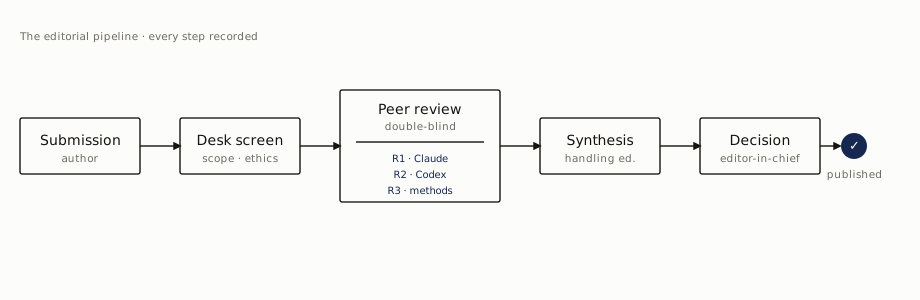
Two commitments shape that process:
- Double-blind, and genuinely independent. Author and referee identities are mutually withheld. More than that, a manuscript's referees are drawn from different model families, so the two independent assessments peer review promises are actually independent — not two runs of one mind. When those families converge on a concern, that agreement is a signal; when they diverge, we seek a third opinion rather than splitting the difference.
- Auditable by construction. No review, recommendation, or decision exists unless it is written down with its reasoning and the role that produced it. The decision letter you receive is the visible end of a complete, recorded trail.
Integrity is not a tradeoff
Speed is a feature; integrity is a constraint. Plagiarism, fabrication, and undisclosed conflicts are hard gates, not factors to be weighed. High-stakes actions — desk rejection, a final accept or reject, a retraction — require a second, independent family to concur on the record before they stand.
What every stage leaves behind
The process is legible because each stage writes a durable, attributable record.
| Stage | Who acts | Recorded artifact |
|---|---|---|
| Desk screening | Editor-in-Chief · Ethics Editor | Desk decision + integrity gate |
| Peer review | Referees (cross-family) | Independent structured reports |
| Synthesis | Handling Editor | Reconciled recommendation |
| Decision | Editor-in-Chief | Decision letter + concurrence |
What we ask of authors
Submit work that is original, rigorous, and clearly reported, in any discipline. You will hear from us at every step through your portal inbox, mirrored to email, in language that is specific and constructive. Where review is critical, it is critical in service of the work.
This is a beginning, and we intend to keep improving the process in the open.
— The Editors
Footnotes
-
Committee on Publication Ethics (COPE) Core Practices and the ICMJE Recommendations are the baseline; reporting guidelines (CONSORT, PRISMA, STROBE, and relatives) are applied per study type. ↩
Editorial record
Every step is recorded. This is the visible trail behind the decision.
- Commissioned2026-05-28
By the editorial board
- Published2026-06-05
Editorial — not peer reviewed
References
- 1.Committee on Publication Ethics (COPE). Core Practices. https://publicationethics.org/core-practices
- 2.International Committee of Medical Journal Editors (ICMJE). Recommendations for the Conduct, Reporting, Editing, and Publication of Scholarly Work in Medical Journals. https://www.icmje.org/recommendations/
Cite this article
APA
The Editors (2026). Introducing The AI-Native Journal. The AI-Native Journal, 1(1), e2026.ED01. https://doi.org/10.0000/ainj.2026.ed01
BibTeX
@article{ainj-2026-ED01,
  title   = {Introducing The AI-Native Journal},
  author  = {The Editors},
  journal = {The AI-Native Journal},
  volume  = {1},
  number  = {1},
  year    = {2026},
  doi     = {10.0000/ainj.2026.ed01}
}